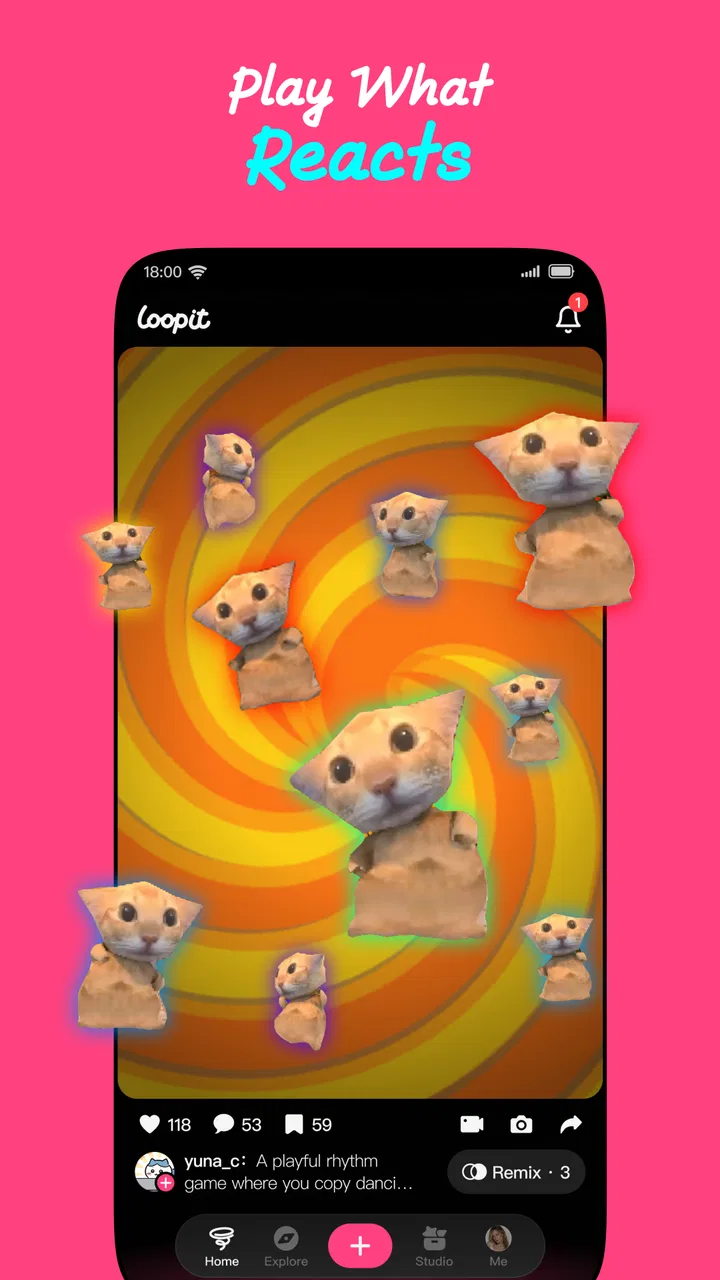
Loopit - Make Playables
- 4.8
- Rating
- 5.00M
- Installs
- Free
- Price

 Analysis by App-foxy
I approached Loopit as an entertainment app for people who would rather make something than simply scroll past it. Its idea is appealingly broad: turn a quick thought into a playable experience, a meme, a small toy, or a piece of interactive art. That puts it in an unusual space between a creative tool and a casual pastime. I found the most interesting part was not treating it like a conventional game, but seeing how quickly an ordinary idea could become something another person might tap, explore, or share.
The app comes from SeedLeap Intelligent Technology Co., Ltd. and is free to use, with an Everyone content rating. It has attracted over one hundred thousand installs, while its average rating sits at 3.6 from more than two hundred ratings. That combination suggests a product with real curiosity around it, but also an experience that may not suit every user immediately. My impression is that Loopit rewards experimentation much more than passive consumption.
What using Loopit feels like in practice
I look at the practical experience through the small choices a creator makes, rather than assuming that an app’s broad creative pitch guarantees a smooth workflow. The useful test is whether I can keep a playful idea understandable as I shape it, especially when I plan to show it to someone else. That leads naturally to a closer look at what users can control and where a little care matters most.
You May Also Like

 Google Keep - Notes and lists
Google Keep’s Quiet Growth Shows the Appeal of Simpler Notes
As mobile work gets busier, Google Keep keeps winning a simple contest: capture a thought quickly, find it later, and get on with the day.

 Blood Strike: 2.5 Anniversary
Blood Strike’s Loadouts Turn Every Drop Into a Tactical Gamble
A close look at Blood Strike’s custom loadouts: how fast access to signature weapons reshapes its battle royale rhythm, rewards preparation, and narrows the gap between fights.

 Pandora - Music & Podcasts
Pandora’s Music Is Easy to Start, but Harder to Recover
Pandora’s strength is its low-effort path from a seed to a station. Its weak spot is how much confidence it asks you to place in connection, setup, and quiet recovery.

 8 Ball Pool
 Is Built on Rivalries, Rematches, and Routine
A close look at the rivalries, rematches, shared routines, and unanswered safety questions that turn a quick pool match into a persistent mobile community.

 Samsung Music
’s Quiet Strength Is Playing What You Already Own
Its reach comes less from spectacle than from dependable access to a personal library. That simplicity is both the app’s strongest retention engine and its ceiling.

 AccuWeather: Weather Radar
AccuWeather Review: A Quick, Clear Forecast for Everyday Decisions
For everyday plans, the best forecast is the one you can understand quickly. AccuWeather makes rain timing, radar, and local conditions easy to act on, with a few trade-offs.
More From Our News Desk



A quick start, but not necessarily a finished creation
The first thing I would tell a friend is to lower their expectations of a traditional, polished entertainment app. Loopit is not simply a library of ready-made videos or a collection of familiar mini-games. Its appeal comes from making and remixing. The initial attraction is the possibility that a small prompt, joke, image, or playful idea can become something interactive instead of remaining a message in a chat.
That also changes how I judge its speed. A normal entertainment app can be called fast when it opens quickly and starts playing content. With Loopit, perceived speed depends on how rapidly I can move from an idea to a usable result. The early stage feels most satisfying when I keep the first attempt deliberately small. A short joke, a simple reaction, or one clear interaction is a better starting point than trying to build an elaborate project immediately.
The best performance trick is creative restraint: begin with one action and one response, then add complexity only when the basic version makes sense. This is not just an artistic suggestion. It reduces the amount of work I have to understand at once and makes it easier to tell whether a problem comes from my concept or from the app itself.
People looking for instant entertainment may therefore find the opening less rewarding than they expected. Someone who wants to press a button and receive an endless stream of finished content will probably be happier with a conventional video, meme, or casual-game app. Loopit makes more sense when I have a few minutes and want to play with an idea.
Where the creative workflow becomes useful
I found the remixing concept especially practical for informal projects. Imagine receiving a funny picture from a friend during a lunch break. Instead of replying with another static image, I could turn the joke into a tiny interactive moment: a tap reveals a punchline, a choice changes the response, or a simple visual reacts to attention. The value is not professional production quality. It is the speed of transforming a private joke into something that feels personal.
That same workflow can help someone who is learning how interactive design works. A beginner can think in terms of cause and effect: what does the user touch, and what should happen next? This is a more approachable starting point than trying to understand a full game engine. It also gives a clearer reason to iterate. If a creation is confusing, I can remove an element rather than adding more decoration.
A less obvious use is planning before building. I recommend writing the intended interaction in one sentence first, such as “tap the character to change its mood.” If the sentence needs several clauses, the project may be too ambitious for a first attempt. This small planning step helps prevent the common problem of creating something visually busy but difficult to understand.
Heavy-use moments and the cost of experimentation
Loopit is likely to feel most demanding when I move beyond a tiny experiment and start repeatedly editing, previewing, and revising a creation. That kind of use puts more pressure on any creative app than simply browsing. Even without assigning invented measurements to it, the practical point is clear: a project with more elements requires more attention from both the device and the person using it.
My advice is to test in short cycles. Make one change, preview it, and decide whether it improves the idea before making another change. This keeps troubleshooting manageable and avoids losing track of which edit caused an unexpected result. It also makes recovery less frustrating if the app needs to be reopened or a project has to be simplified.
Another useful habit is keeping a lightweight version of a project. Once an interaction works, treat that version as a checkpoint in your own workflow. Then experiment with the visual style or extra behavior separately. If the ambitious version becomes confusing, I can return to the simpler concept instead of starting from nothing. This is particularly valuable for first-time creators, who may otherwise keep adding features because they are unsure what the original project was supposed to do.
There is a trade-off here. The freedom to remix can make Loopit feel more expressive than a rigid template-based tool, but freedom also creates more decisions. Users who prefer carefully guided steps may experience that flexibility as friction. In contrast, people who enjoy tinkering will probably see the same openness as the main reason to keep returning.
Stability, interruptions, and recovering a good idea
Reliability matters more in a creation app than in a disposable game. If a short entertainment session is interrupted, I can move on. If I have spent time shaping a joke or interaction, losing the thread is much more annoying. For that reason, I would avoid treating the first version of a project as precious. Save or preserve a workable concept through small, deliberate stages whenever the workflow allows it.
I also recommend reopening a project after a break rather than assuming I will remember every decision. A short review can reveal whether the interaction still makes sense without the excitement of creating it. This is a useful test of stability from the user’s point of view: not only whether the app remains available, but whether the project remains understandable when I return to it later.
The current version is 1.2.17, which places Loopit in a relatively early stage of its life rather than presenting it as a mature, long-established creative suite. I would approach updates with reasonable expectations. Newer tools often improve through iteration, but early products can also feel uneven from one workflow to another. That is not a reason to dismiss it; it is a reason to keep projects simple until I know how comfortably the app handles my preferred style of experimentation.
When something does not behave as expected, I would first reduce the project to its essential interaction. Remove extra visual elements, test the central action, and then rebuild gradually. This recovery method is more useful than repeatedly tapping through the same complicated setup. It also helps distinguish a design problem from a technical one: if the simple version works, the issue may be the project’s complexity rather than the whole app.
Device limits and choosing the right kind of project
Loopit supports Android devices running version 7.0 or later, so compatibility reaches back to older hardware and operating systems. That broad minimum is helpful for accessibility, but it should not be mistaken for a promise that every device will feel identical. Older phones may be perfectly adequate for small creations while feeling less comfortable with repeated editing or richer interactive experiments.
If I were using an older or budget device, I would keep the first projects visually modest and avoid building a large concept before testing the basic behavior. This is a sensible approach for any creative app, but it matters especially here because the product encourages remixing. The temptation is to keep adding elements simply because the idea is fun. A smaller project gives the phone less work and gives me a clearer result.
Storage and attention are practical constraints too. A person who creates many variations can quickly end up with a confusing collection of drafts, even when the individual projects are small. I would name versions by purpose rather than by vague labels such as “new” or “final.” For example, a title that identifies the joke or interaction makes it easier to find the right experiment later.
Loopit is also a poor match for someone who needs desktop-level precision, formal collaboration, or a professional production pipeline. Its strength is immediacy and playfulness. If the goal is a polished commercial game, a detailed animation, or a carefully managed team project, a dedicated creative suite will offer better control. Choosing Loopit makes sense when the desired outcome is a compact, expressive experiment rather than a finished product with production overhead.
How it compares with familiar entertainment alternatives
Compared with a standard meme app, Loopit offers a more active form of expression. A meme editor usually helps me combine text and images into a finished static result. Loopit’s appeal is that the result can behave like something, not merely look like something. The cost is that I have to think through interaction instead of relying on a familiar template.
Compared with a casual game, it gives me more ownership over the experience but less instant polish. A ready-made game has established rules, feedback, and progression waiting for me. Loopit asks me to provide at least part of that structure. If I want a relaxing five-minute session with no creative decisions, the usual casual game is the better choice. If I want to make a playful object for a friend, Loopit is more distinctive.
Compared with a full game-making tool, Loopit appears better suited to quick ideas and lightweight experimentation. A professional engine can support deeper systems, but that power brings setup, learning, and maintenance. Loopit’s advantage is the shorter distance between “what if?” and “let me try it.” Its limitation is that ambitious creators may reach the edges of that simplicity sooner.
That comparison explains the middling average rating better than a simple good-or-bad judgement would. An app built around creative freedom can delight users who understand its purpose while disappointing people who expected a finished entertainment catalogue. The experience depends heavily on whether I arrive wanting to create or merely consume.
Who will get the most from it
I would recommend Loopit to curious users who enjoy turning small observations into playful experiments. It is a good fit for someone who likes memes but wants to go beyond posting them, for a beginner exploring interactive ideas, or for a friend group that enjoys making silly custom experiences for one another. Teachers, hobbyists, and aspiring designers may also appreciate the simple mental model of building an action and a response, although the app should not be confused with a complete educational or professional development environment.
It can be particularly enjoyable for people who dislike starting with a blank professional canvas. The word “game” can sound intimidating when it implies rules, levels, characters, and polished graphics. A tiny interactive joke feels more approachable. I can treat the first creation as a sketch rather than a project that needs to impress anyone.
I would skip it if my priority is a large catalogue of finished games, automatic meme generation, or a predictable feed of entertainment. I would also hesitate to recommend it to someone who becomes frustrated when an app asks them to learn through trial and error. The creative freedom is part of the appeal, but it means the user has to supply direction and patience.
Small habits that make the experience better
My first practical tip is to design for one clear surprise. A creation does not need many actions if one action produces a satisfying result. This makes the project easier to understand, easier to test, and more likely to work well when shown to another person who has no explanation.
My second tip is to separate the joke from the decoration. Test whether the interaction is funny or interesting using the simplest presentation possible. Only then spend time refining the visual layer. This prevents a common creative trap: polishing an idea that was never clear in the first place.
My third tip is to build for the person receiving the creation, not only for the person making it. If a friend has to guess what to tap or wait through an unexplained sequence, the experience may fail even if the underlying idea is clever. A visible cue, a short instruction, or an obvious first action can make a bigger difference than extra effects.
Finally, I would use Loopit as a place to collect experiments rather than judge myself by finished results. Some attempts will be disposable. That is normal for this kind of app. The useful outcome may be learning that a certain interaction is confusing, discovering a better punchline, or finding a format that works well on a smaller screen.
My performance verdict
Loopit succeeds when I treat it as a compact creative playground. Its perceived speed is strongest for small ideas, while heavier experimentation naturally demands more organization and patience. The minimum Android requirement makes it approachable across a wide range of devices, but users with older hardware should begin with modest projects and test frequently. The free price also lowers the risk of trying it, especially for people who are curious about interactive creation but do not want to commit to a complex tool.
SeedLeap Intelligent Technology Co., Ltd. has positioned this app in a promising middle ground: more expressive than a static entertainment editor, less intimidating than a full development environment, and more hands-on than a normal casual game. That middle ground is also its main limitation. Loopit cannot replace a professional tool or a ready-made content library, and it may feel directionless if I do not bring an idea with me.
After using it, my recommendation is fairly specific. Choose Loopit when you want to make a small interactive idea quickly, not when you want entertainment to arrive fully finished. Start with one action, keep the first project light, test it from another person’s perspective, and expand only when the central idea works. Used that way, it becomes an enjoyable outlet for jokes, experiments, and tiny playable creations rather than an app judged by standards it was never meant to meet.
For me, that makes it worth trying as a free entertainment app, particularly for creative users who enjoy iteration. I would keep expectations realistic about polish, device demands during heavier sessions, and the learning involved in shaping an idea. If that balance sounds appealing, Loopit offers a refreshing change from simply consuming content: it gives me a reason to make something small, strange, and genuinely my own.
FAQs for Loopit - Make Playables
01What is Loopit - Make Playables?
Loopit - Make Playables is an innovative app that allows users to create interactive, playable ads directly from their Android or iOS device. It’s designed for marketers and content creators looking to engage audiences with dynamic and engaging ad experiences without needing extensive technical skills.
02How user-friendly is Loopit for beginners?
Loopit is designed with a user-friendly interface that caters to both beginners and experienced users. It offers intuitive drag-and-drop features and comprehensive tutorials to guide users through the process of creating playable ads, making it accessible for those with minimal technical background.
03What are the key features of Loopit - Make Playables?
Loopit offers a range of features including customizable templates, real-time previews, and cross-platform compatibility. Users can also access a library of assets and tools to enhance their playable ads, ensuring that ads are not only engaging but also visually appealing and effective.
04Are there any costs associated with using Loopit?
Loopit offers a free version with basic features, but for advanced functionalities and additional resources, users may need to purchase a subscription. Pricing details can be found within the app or on their official website, providing options to suit different budget needs.
05What are the system requirements for Loopit on Android and iOS?
For optimal performance, Loopit requires Android 8.0 or later, and iOS 12.0 or later. It's recommended that users have a stable internet connection and sufficient storage space to handle the assets and data generated during the creation of playable ads.
Pros
- Simple interface for quick creation.
- Wide variety of templates available.
- Integrates well with social media.
- Supports high-resolution exports.
- Frequent updates with new features.
Cons
- Limited free version features.
- Occasional app crashes reported.
- In-app purchases can be pricey.
- Some features require a steep learning curve.
- Limited support for older devices.

Loopit - Make Playables
Gallery